

April 28, 2026
First Contact
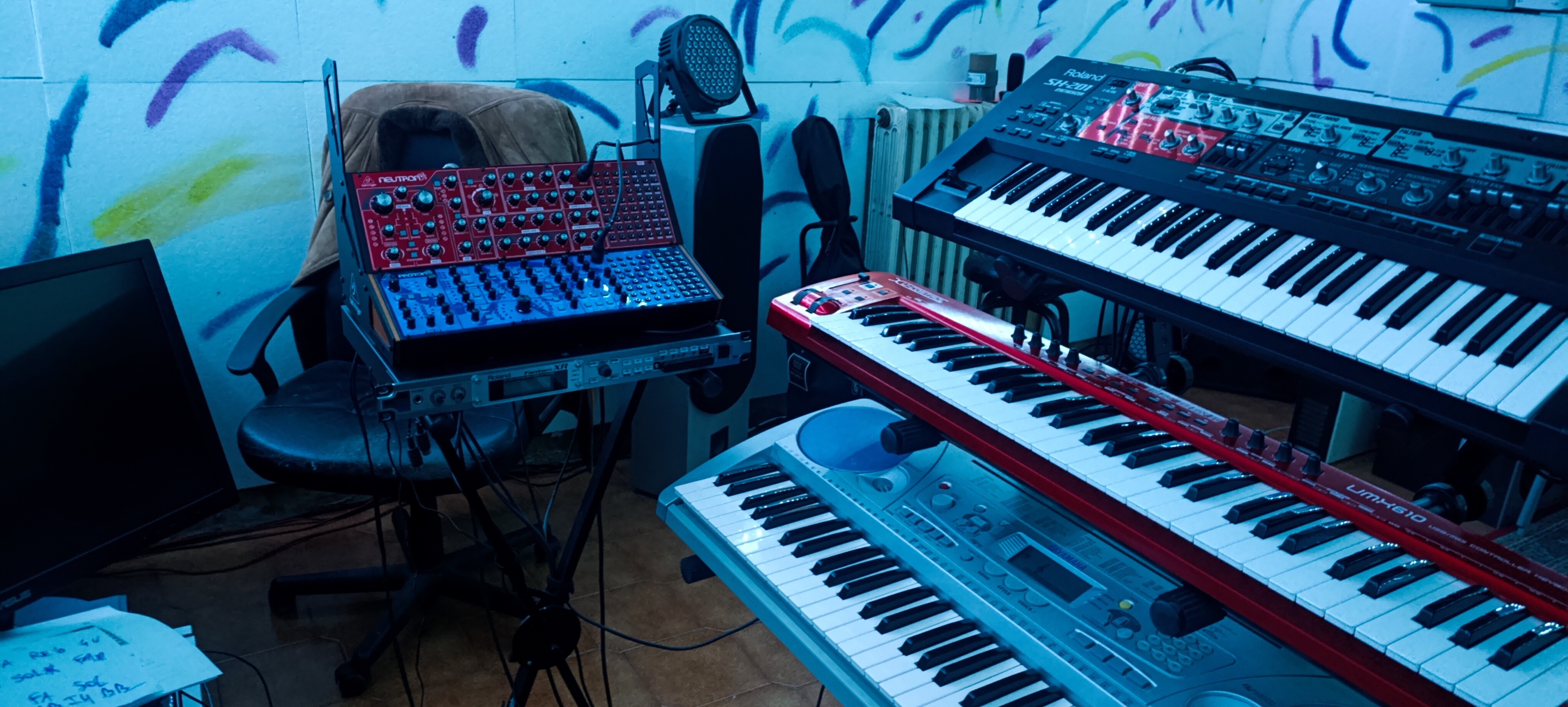
Today I want to talk to you about the first impact. However, there is a fundamental concept to clarify: synthesizers like the Neutron and Proton offer no way to save the sounds you create. These machines are sensitive to variations in temperature and humidity; they are often rebellious. This means they are not easy to manage, neither in the studio nor live, but... they possess that unique sound that belongs only to Ross54, a sound that no one will ever be able to reproduce with absolute fidelity.
This makes every performance, whether in the studio or in live situations, unique and unrepeatable. It doesn’t mean the reproduced sound is completely different every time, but certain nuances—often undetectable to the casual listener—certainly are. Only we know how the sounds are dialed in, what waveforms we use, and how the filters are tuned to give warmth, acidity, or sweetness to a sound. A semi-modular, fully analog synthesizer is almost a living creature: you have to know it and talk to it. It can be a curse or a faithful friend; it all depends on how you understand it, on how you approach it.
Yesterday, we integrated the Proton into the setup at Galactica. Beyond the mere assembly and updates, there was, of course, the introduction and the beginning of the dialogue: man-to-machine and machine-to-machine. Neutron and Proton share the same core electronics, so entering the main calibrations wasn't difficult, but they have a marked and substantial difference in filter management. Furthermore, the Proton, being a generation ahead of the Neutron, features several additional settings.
It took a trial session lasting a good 5 hours to gain some relative confidence, but in the end, we managed to make the two machines talk to each other and, above all, talk to us. We were pleasantly impressed by the resulting sound: together, these two machines manage to create an absolutely exceptional sonic density. Despite having completely different voices, they are complementary, achieving an incredible level of layering and sonic clarity.
If we were enthusiastic about the Neutron, we are even more so about the Neutron/Proton duo. It requires study, research, and a lot of patience, but the results obtained are absolutely significant. This is also why Ross54 decided to re-record the tracks that were already finished (a decision already made when we changed the hardware and software systems in the studio) and why we decided to withdraw the preview, as it is now obsolete.
Galactica has taken great and rapid evolutionary steps during this period. We have put in the effort—believe me, a great deal of it—and passion. So much passion.